

How to Choose Certified Compostable Bin Bags
Quick Summary
Choose certified compostable bin bags by checking for a recognised certification mark, such as EN 13432, rather than relying on the word biodegradable or an eco logo. Match the certification to your disposal route, whether council food-waste collection or home composting, then confirm the size fits your caddy or bin.
- Biodegradable is a looser claim; many such products leave fragments behind.
- EN 13432 certifies breakdown under industrial composting conditions, not home composting.
- A logo with no certificate number is a common red flag.
- Measure your caddy or bin, not just litre capacity, before buying.
- Check your local council's accepted liners, since local guidance overrides general advice.
Table of Contents
- Compostable vs Biodegradable Bags: Why the Label Matters
- Checking for EN 13432 and Other Certification Marks
- Matching Bag Size and Thickness to Your Bin and Council Rules
- Booking Your First Eco Green Living Order Without Guesswork
- Frequently Asked Questions
Compostable vs Biodegradable Bags: Why the Label Matters
Last Updated: November 19, 2026
Choosing certified compostable bin bags starts with one distinction: "biodegradable" and "compostable" are not the same, and a bag labelled only biodegradable may not break down in a food waste caddy or home compost heap. Eco Green Living's compostable bin bags are made from PBAT, corn starch and PLA and are certified compostable to EN 13432 by TÜV Austria and DIN Certco.
Compostable means a product breaks down into water, carbon dioxide and biomass within a set time, in defined conditions, without toxic residue. Biodegradable is a looser claim: many such products leave fragments behind.
Look for a recognised certification mark rather than the word "eco" on the front of the pack. For a broader comparison of plastic-free bin bag sizes, strength and cost, see this guide to plastic-free bin bags. Eco Green Living's bags carry EN 13432 certification from TÜV Austria and DIN Certco, so you can check the claim yourself.
Checking for EN 13432 and Other Certification Marks
EN 13432 is the standard for packaging recoverable through industrial composting. It requires breakdown within a defined timeframe under controlled industrial conditions, disintegration with no visible residue, and no harm to the resulting compost. It does not certify home compost breakdown.
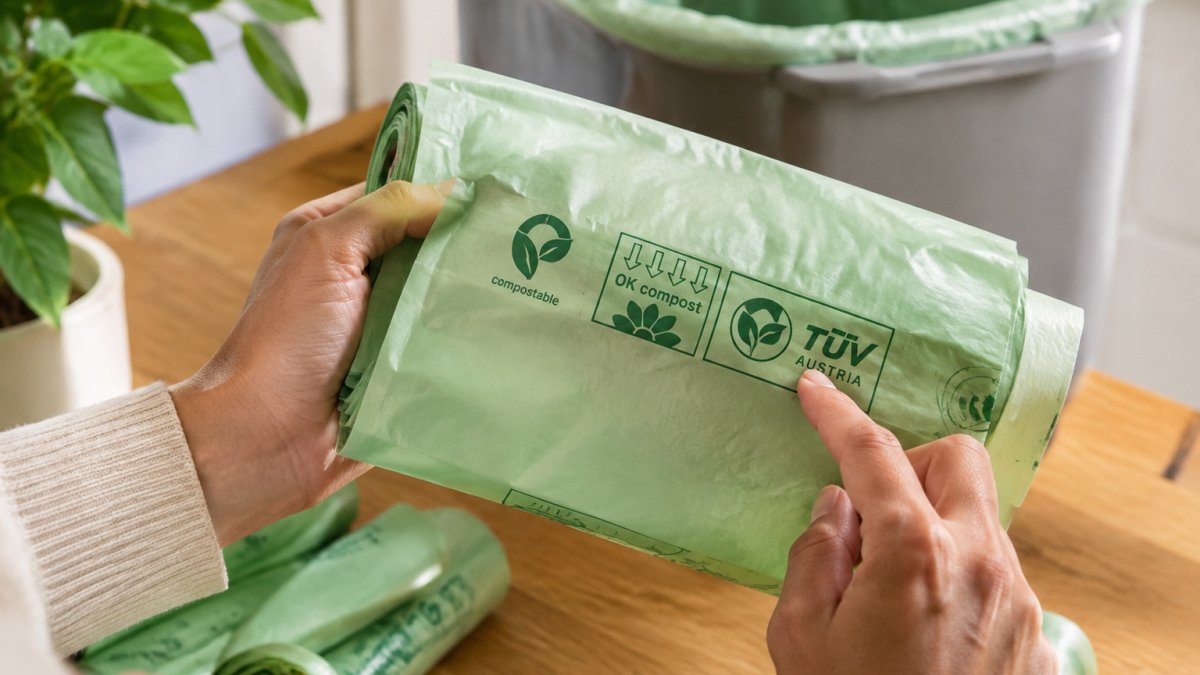
The mark on the pack tells you which end-of-life route the bag was tested for. Match the mark to how you will actually dispose of the bag:
- Council food-waste collection: look for EN 13432 certification from a recognised body, and check the certifier's logo and registration number. Council collections typically send food waste to industrial composting or anaerobic digestion.
- Home composting: look for a home-compostable certification, not just EN 13432, because home systems run cooler and less consistently.
- Commercial processing facility: confirm with the facility which standard it accepts before you buy.
To verify a claim, check the standard named, the certifier's logo and certificate number, and the certifier's database to confirm the product and conditions covered. For a deeper checklist for judging compostable bags, read how to choose compostable bags with seven checks. A logo with no certificate number is a common red flag.
| Claim on pack | What to look for | Suits |
|---|---|---|
| EN 13432 certified | Named standard, certifier logo and certificate number | Industrial composting and council food-waste collections |
| Home compostable | A home-compostable certification, not EN 13432 alone | Garden heaps and home compost systems |
| Biodegradable only | No standard named | Not a reliable choice for any composting route |
| Plastic-free | No compostability standard | Tells you about material, not end-of-life |
Watch out: a bag can be genuinely certified and still be rejected by your local collection if the council's rules differ from the certification scope, so always check local guidance alongside the mark.
Matching Bag Size and Thickness to Your Bin and Council Rules
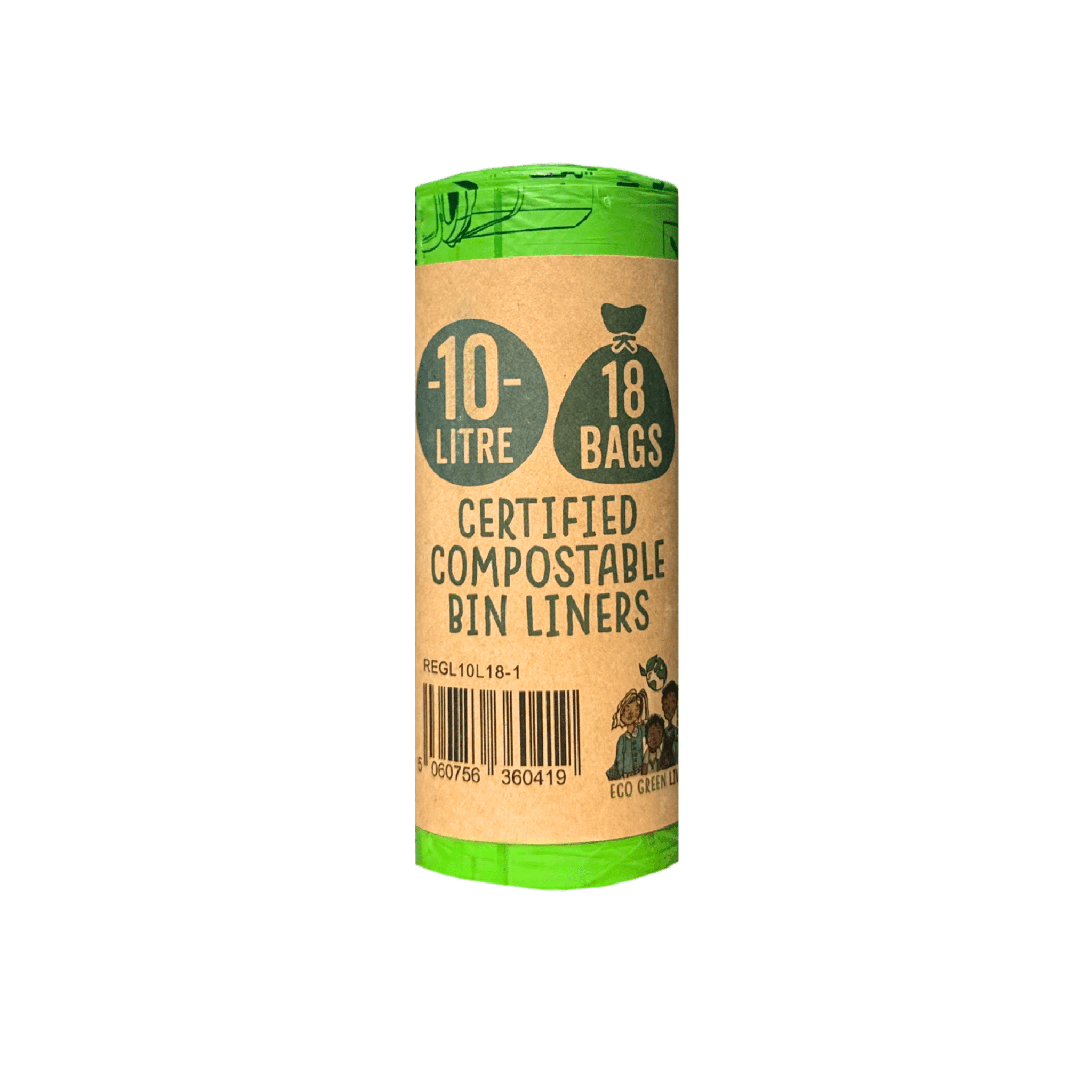
Measure your caddy or bin rather than guessing. A bag too small tears at the rim; one too large wastes material and can slump into the base. As a guide, 10L suits a kitchen caddy, 30L a standard household bin, and 40L to 60L larger loads. Check stated dimensions as well as litre capacity.
Thicker bags resist tearing and leaking with wet food scraps but use more material; thinner bags suit light, dry kitchen waste. Pick the thinnest option that will not split under your typical load, and test a single roll first.
Council food-waste rules vary, and local guidance overrides any general recommendation. Before you buy, run this checklist:
- Check your local authority's food-waste collection page for which liners are accepted.
- Confirm whether the council requires certified compostable liners, allows any liner, or asks for none.
- Check whether food waste goes to industrial composting or anaerobic digestion, and whether an accepted standard is named.
- Look for restrictions on bag size or material.
- If unclear, contact the waste team and ask which certification they accept.
Store bags dry and away from heat, and empty caddies regularly, especially in warm weather. If bags stick together, store them cool and dry; if a bag tears at the rim, check the size matches the caddy.
Bring the whole decision together with a neutral selection checklist:
- Certification: the mark matches your disposal route.
- Dimensions: fits your caddy or bin without overhang.
- Thickness: resists your typical load without excess material.
- Capacity: suits how often you empty the caddy.
- Material: you understand how it breaks down.
- Intended use: the pack states the route it is designed for.
Watch out: a certified bag can still fail if stored damp or left too long with wet waste, so match the bag to your habits as well as your bin.
Booking Your First Eco Green Living Order Without Guesswork
Once you know your bag size and certification, choose a pack from our range. Our 10L Compostable Waste Bags (1 Roll of 18 Bags) cost £4.50 and suit a kitchen caddy. The 30 Litre Compostable Waste Bags (1 Roll of 18 Bags) cost £4.50 for a standard bin, and the 40L Bin Bags (1 Roll of 24 Bags) cost £9.00 for a larger load.
Order a single roll first to test how the bag handles your waste; if it fits your caddy and your council accepts it, order more.
Frequently Asked Questions
How can you tell if a bin bag is certified compostable?
Look for a named certification on the packaging, such as EN 13432, which is the European standard for compostable packaging, and a logo from an independent certifier like TÜV Austria or DIN Certco. A claim such as 'eco-friendly' or 'biodegradable' on its own is not evidence of certification. Eco Green Living's 10L Compostable Waste Bags (£4.50 for a roll of 18) list EN13432 certification by TÜV Austria and DIN Certco on the product page, so you can see exactly which standard applies before you buy.
Are compostable bin bags suitable for food waste caddies?
Yes, if the bags are certified compostable and your local collection accepts them. Compostable bin liners are sized for kitchen caddies and small bins and are designed to break down alongside food scraps. Eco Green Living's 10L Compostable Waste Bags are made for food waste caddies and small kitchen bins, and are described as strong enough for a full week of food scraps. Always check your council's guidance, because some collections only accept specific bag types.
Can certified compostable bags go in a council food waste collection?
This depends on your local authority. Many councils across the UK accept certified compostable liners in food waste collections, but some only accept loose food or specific liner types. Check your council's website or collection leaflet before you buy a large quantity. If your council accepts compostable liners, a certified product with a clear EN 13432 mark is the safest choice, since it signals that the bag is designed to break down at a commercial composting facility.
Price of compostable bin bag rolls at Eco Green Living
