

Best Plastic Free Bin Bags 2026: Sizes, Strength and Cost
Last Updated: October 30, 2026
Quick Summary
The best plastic free bin bags in 2026 fit your bin, hold the load and break down where your council or compost heap can process them. Our compostable liners run from 8 to 140 litres, and the 10L and 30L rolls work out cheapest per bag at £0.25 each.
- A liner only made our list if it carries third-party compostability certification, not just an eco label.
- EN13432 covers industrial composting only, while AS5810 is the Australian home composting standard.
- The 60L compostable liner is built at 25 microns for daily performance with food scraps.
- A household using one 30L liner a day spends roughly £7.50 a month at that rate.
- Eco Green Living offers a flexible subscription model with up to 55% savings.
Table of Contents
- Quick Comparison: Plastic Free Bin Bags by Size and Cost
- How We Chose the Best Plastic Free Bin Bags
- Compostable Bin Bags: What the Certifications Actually Mean
- Food Waste Caddy Liners for Kitchen and Kerbside Collections
- Home Compostable Bin Bags: Home Heap Versus Industrial Breakdown
- Compostable Bin Bags That Do Not Leak: Strength and Fit Checks
- Choosing the Right Size and Cost Per Bag
- Building Your Plastic Free Bin Bag Subscription
- Frequently Asked Questions
Quick Comparison: Plastic Free Bin Bags by Size and Cost
Plastic free bin bags are liners made from plant-derived materials rather than polyethylene.
Here is the whole range side by side. Cost per bag is the number that matters, not the price on the roll.
Size |
Bags per roll |
Price |
Cost per bag |
Best for |
|---|---|---|---|---|
8L drawstring |
25 |
£9.99 |
£0.40 |
Bathroom, bedroom, office bins |
10L |
18 |
£4.50 |
£0.25 |
Kitchen caddy, small food bins |
30L |
18 |
£4.50 |
£0.25 |
Standard kitchen bins |
40L |
24 |
£9.00 |
£0.38 |
Family kitchen bins |
60L |
10 |
£5.00 |
£0.50 |
Larger kitchen and office bins |
80L |
20 |
£11.00 |
£0.55 |
Utility rooms, heavy general waste |
140L |
5 |
£6.00 |
£1.20 |
Wheelie bins, garden clearance |
The 10L and 30L rolls work out cheapest per bag: you pay for the bag, not the size, so small liners on long rolls beat large liners on short ones.
How We Chose the Best Plastic Free Bin Bags
Our first filter was certification, not price. A liner only made this list if it carries third-party compostability certification, because a bag labelled "eco" with no certificate tells you nothing about what happens to it after collection.
The second filter was fit: does each size have handles or a drawstring, and does the stated capacity match the bins people actually own? The third was cost per bag, calculated above from the roll price.
Compostable Bin Bags: What the Certifications Actually Mean
Most confusion around plastic free bin bags comes from three words used as if they mean the same thing. They do not, and the difference decides where the bag can go after you tie it.
Plastic-free is a materials claim, not a disposal claim.
Biodegradable is the weakest of the three. It means the material will eventually be broken down by micro-organisms, but it sets no timeframe, no required end product, and no independent test.
Compostable is the only one with a defined, testable meaning: the product breaks down into non-toxic compost within a specified time under specified conditions, verified by an independent body.
Reading the certificate, not the packaging
A genuine compostability claim points to a standard and a certification body. The two you will see most often on liners sold here are:
- EN13432, the European standard for packaging recoverable through industrial composting. A bag certified to it is designed for a commercial facility that reaches sustained high temperatures. It is not a home-composting claim.
- AS5810, the Australian standard for home composting, which tests breakdown at ambient garden-heap temperatures. If you plan to put the liner in your own heap, this is the mark to look for.
- AS4736, the Australian industrial composting standard, the counterpart to EN13432.
A liner certified to both an industrial and a home standard gives you a choice of disposal route. A liner certified only to EN13432 belongs in industrial composting or a council collection that accepts it, not on your garden heap.
How to check a certificate in practice
- Find the standard number and the certification body on the pack or product page. A logo alone is not enough; you want the standard (EN13432, AS5810, AS4736) and the body that issued it.
- Check the certificate covers the product, not just the material. A supplier may hold a certificate for a resin while the finished bag, with its seams, handles and print, is a different article. Ask whether the certificate names the finished liner.
- Look for a registration or certificate number you can cross-check with the certification body.
- Check the scope. Industrial-only certification is not a home-composting claim, and a home certificate does not guarantee your particular heap will be hot enough.
Matching the term to the disposal route
Label |
What it guarantees |
Where it can go |
|---|---|---|
Plastic-free |
No conventional plastic |
Depends on the material, check the compostability claim separately |
Biodegradable |
Eventual breakdown, no timeframe |
Not a reliable disposal instruction on its own |
EN13432 compostable |
Industrial composting to a defined standard |
Industrial facility, or a council collection that accepts compostable liners |
AS5810 home compostable |
Breakdown at garden-heap temperatures |
Home compost heap, plus industrial routes where also certified |
One thing certification does not tell you is whether your council accepts compostable liners in its food waste collection. That varies by authority, and no certificate overrides the collection rules where you live. We cover that in more detail in our guide to whether compostable bin bags are allowed in food waste collections.
Food Waste Caddy Liners for Kitchen and Kerbside Collections
Food waste caddy liners are the one category where getting the size right is almost the whole job. Too big and the liner bunches at the bottom of the caddy and traps liquid; too small and it slips off the rim mid-week.
The 8L drawstring option at £9.99 for 25 bags suits bathroom, office and bedroom bins, and can also be used for a larger food compost caddy. The bags are suitable for home composting, minus the tie part.
If you are new to caddies and want the full routine, our guide to lining a food waste caddy without plastic walks through it step by step. You can also browse the full caddy liners range to match a liner to your specific caddy.
Home Compostable Bin Bags: Home Heap Versus Industrial Breakdown
Home compostable bin bags are liners certified to break down in a garden compost heap, a very different environment from an industrial facility.
That is why the AS5810 home certification matters. The 8L drawstring bags are third-party certified as industrial compostable and are also suitable for home composting, minus the tie part.
80L Bin Liners | 1 Roll of 20 Bags | Eco Green Living →
Watch out: even a home-certified liner needs the heap to be working.
Compostable Bin Bags That Do Not Leak: Strength and Fit Checks
Compostable bin bags that do not leak come down to three things: film thickness, handle design, and whether the bag is actually the right size for the bin. Most leak complaints trace back to fit rather than the film.
A simple home test protocol
What we can do is set out the checks a household can run in a few minutes with a full bag. Run them on the first liner of a new roll so you know how the rest will behave.
- The load test. Fill the liner to roughly three-quarters with your normal kitchen waste, including something wet. Lift it clear of the bin by the handles and hold for ten seconds. Watch the base and the seam where the handle meets the body.
- The leak check. Sit the filled bag on a sheet of kitchen paper for two minutes. Any damp patch is a sign the film is too thin for wet waste, or that the base has been stretched by an oversized fit.
- The tear check. Gently pull the handle away from the body at the join. A handle that detaches under moderate pull is the most common failure point on compostable liners.
- The lift-and-carry check. Carry the bag to the bin as you normally would. If it swings and the base bulges, the load is too heavy for that size and you should size up or double-bag.
What thickness actually tells you
The 60L compostable liner is built at 25 microns for reliable daily performance with food scraps and mixed waste. Thinner liners suit dry waste, paper, packaging, bathroom bins, while thicker film suits wet food scraps and heavier loads.
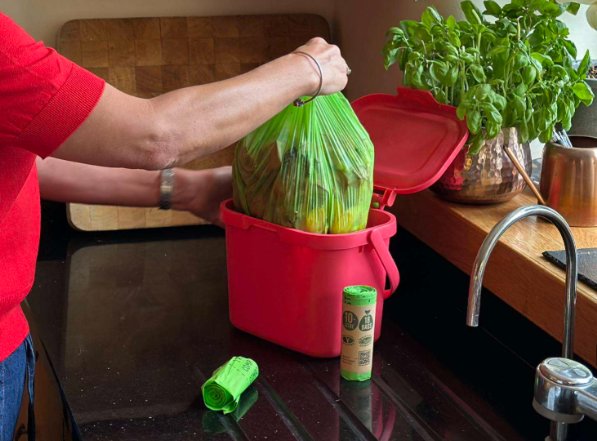
Hands lifting a full compostable bin bag with tie handles out of a kitchen pedal bin
Fit is the part most people skip
A bag that is too large for the bin leaves folds at the base where liquid collects and weight concentrates, and that is where splits start. Measure the height and rim width of your bin before ordering, and size down rather than up if you are between two options. A liner that sits snugly around the rim and reaches the base without bunching will outperform a thicker bag that is the wrong size.
- Check the micron figure if the listing gives one; thinner liners suit dry waste, thicker ones suit wet food scraps.
- Prefer tie handles or a drawstring over open tops for anything heavy.
- Do not overfill. A liner loaded past the rim puts the seam under tension the moment you lift it.
Where compostable film differs from polythene
Compostable film is not polythene, and it does not behave like it. It is strong and tear-resistant for daily kitchen use, but it has less stretch and less resistance to a sharp edge. Bones, broken crockery, skewers and heavy glass will still find a way through, however thick.
What we cannot tell you is that any compostable liner is unbreakable.
Choosing the Right Size and Cost Per Bag
Match the liner to the bin, then check the cost per bag before you commit to a roll. The table below is the decision rule we would give a friend.
Your bin |
Liner size |
Why |
|---|---|---|
Bathroom, bedroom, office |
8L |
Small, drawstring seal, cheap per bag |
Kitchen caddy or food bin |
10L |
Sized for caddies, home compost certified |
Standard kitchen pedal or swing bin |
30L |
Fits most household bins, £0.25 per bag |
Family kitchen bin, heavy loads |
40L or 60L |
More capacity, thicker film |
Utility room, bulky general waste |
80L |
Tie handles, tear-resistant |
Wheelie bin, garden clearance |
140L |
Built for full outdoor loads |
If you want to compare a multi-roll option before committing, the 30 litre compostable waste bags, four rolls of 18 is the size most households settle on, and buying in bulk is where the cost per bag drops furthest.
Building Your Plastic Free Bin Bag Subscription
A subscription makes sense once you know your sizes, because the worst outcome with compostable liners is running out mid-week and buying whatever plastic bags the corner shop has.
Start with the two sizes that cover 90% of your waste: a 10L for the caddy and a 30L or 40L for the kitchen bin. Add a 140L roll only if you line a wheelie bin.
On price: yes, our liners cost more per bag than supermarket plastic.
The real test of a plastic free bin bag is not the label, it is whether it survives the walk to the bin and breaks down where you actually send it.
Frequently Asked Questions
Are compostable bin bags genuinely plastic-free?
The certified ones are. Eco Green Living bags are made from corn starch, PBAT and PLA, plant-derived materials that leave no microplastics behind, and they carry EN13432 certification from TÜV Austria and DIN Certco. Watch out for oxo-degradable bags, which are conventional plastic with an additive that only fragments. Check the certification logo on the pack rather than the word biodegradable, which has no legal definition for bags sold as general waste liners.
What is the difference between biodegradable and compostable bin bags?
Biodegradable only means the material will eventually break down, with no timescale or residue standard attached. Compostable means it breaks down within a set period to a set standard, leaving no toxic residue or microplastics. The EN13432 standard requires 90% breakdown within 12 weeks in industrial conditions. For food waste caddy liners, councils want certified compostable bags, because biodegradable ones can contaminate the collection.
Do compostable bin bags break down in a home compost bin?
Some do, some only in industrial conditions. Eco Green Living bags are certified to EN13432 for industrial composting, and some listed sizes are also certified to AS5810 for home composting. Home heaps run cooler than industrial facilities, so expect slower breakdown, and remove drawstring ties before adding bags to a garden heap. If your heap rarely gets above lukewarm, an industrial-certified bag is the safer choice.
How do I stop compostable bin bags leaking or splitting?
Match the bag to the bin and the load. A 30L liner in a 40L bin stretches and tears, while a 10L caddy liner will not hold a week of general waste. Let wet food cool and drain before it goes in, and press sharp packaging edges flat. Eco Green Living's 60L bags are built at 25 microns for daily kitchen use, and the 80L liners have easy tie handles for heavier loads.
Are compostable bin bags better for the environment than recycled plastic bags?
It depends where they end up. Compostable bags only deliver their benefit when they reach composting, either a home heap or a council food waste collection. Sent to landfill, they behave much like any other bag. Recycled plastic bags avoid new plastic production but still persist for decades. If your council collects food waste, certified compostable liners keep that stream clean and divert both scraps and bag from landfill.
